The well pump refuses to wake
The pump needs power. The utility is down. The pressure falls. Grid Goblin tapes a sign to the well house: “Source available. Delivery cancelled.”
Grid Goblin has learned the property’s secret: the well is full of water, but the pump needs power. Hydro-Sensei teaches the crew that a well is not a water plan unless the pump, storage, pressure, controls, and backup power are ready.
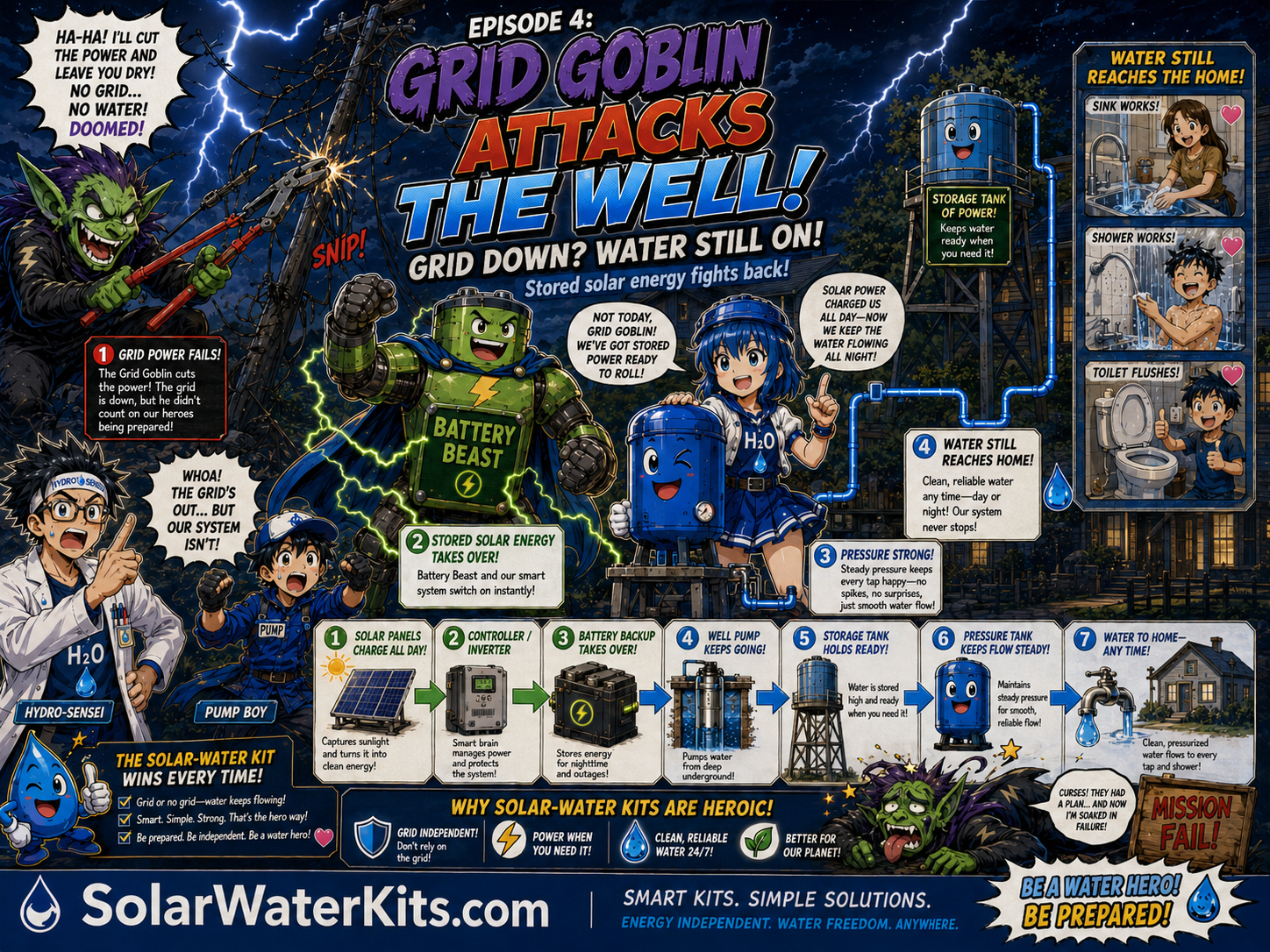
Episode 4 teaches the solar well pump lesson: water source, pump power, storage, pressure, and safety must be designed as one chain.
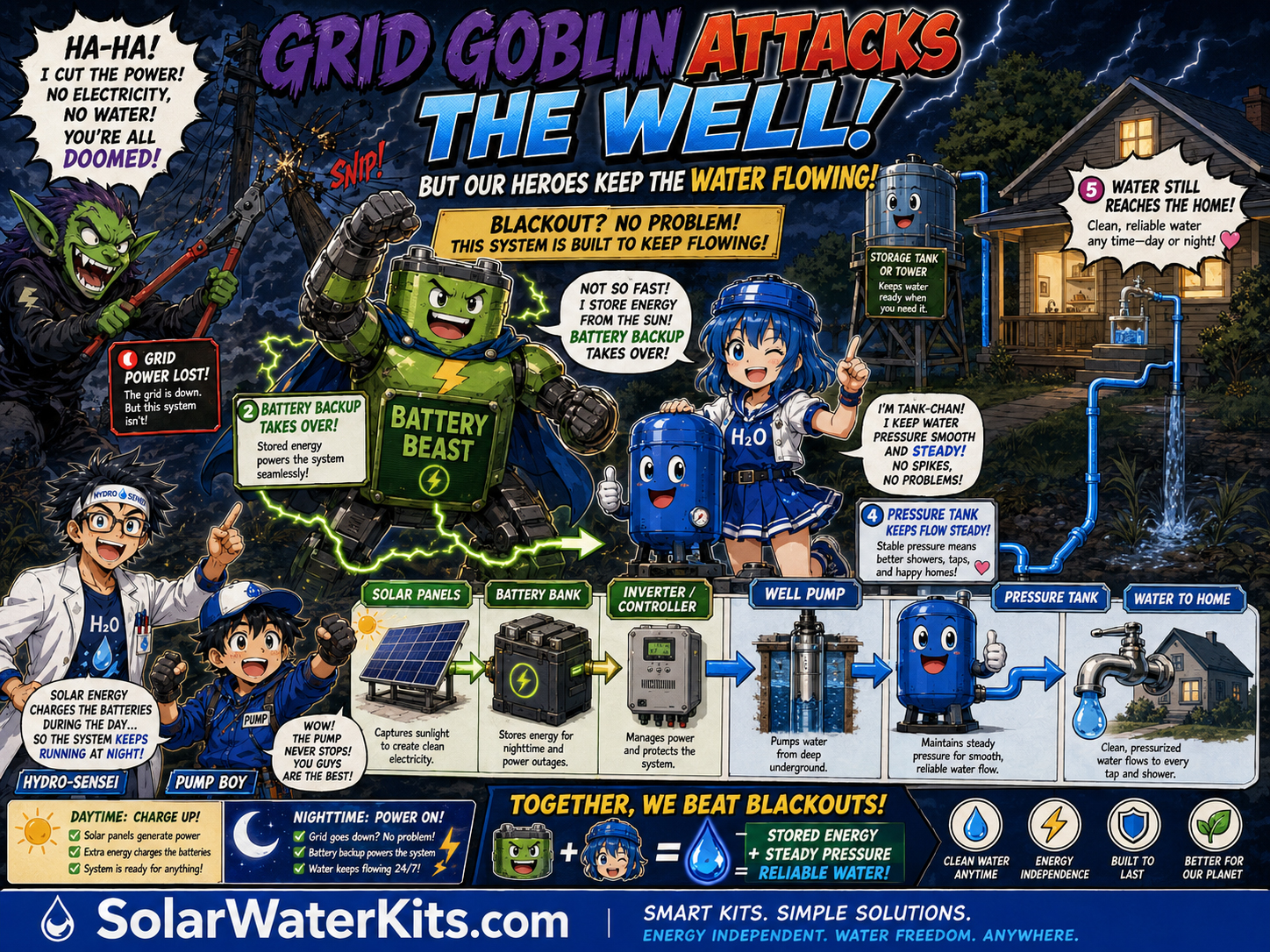
The well may contain water, but the electric pump still needs a power plan.
Grid Goblin sneaks through the dark with a clipboard labeled “Things That Depend on Electricity.” He circles the well pump three times and cackles.
Pump Boy hears the well house go quiet and runs outside in panic.
The pump needs power. The utility is down. The pressure falls. Grid Goblin tapes a sign to the well house: “Source available. Delivery cancelled.”
Battery Beast lumbers toward the critical-load panel. “I can help,” he says, “but I need to know the pump’s voltage, surge, and runtime.”
Tank-chan rolls beside the storage tank. “Even when the pump works, we should store water before the emergency.” Pump Boy writes “tank first” on his sleeve.
Hydro-Sensei writes: well → pump → controller → storage → pressure → treatment → use.
Grid Goblin tries to erase “storage,” but Tank-chan sits on the chalk.
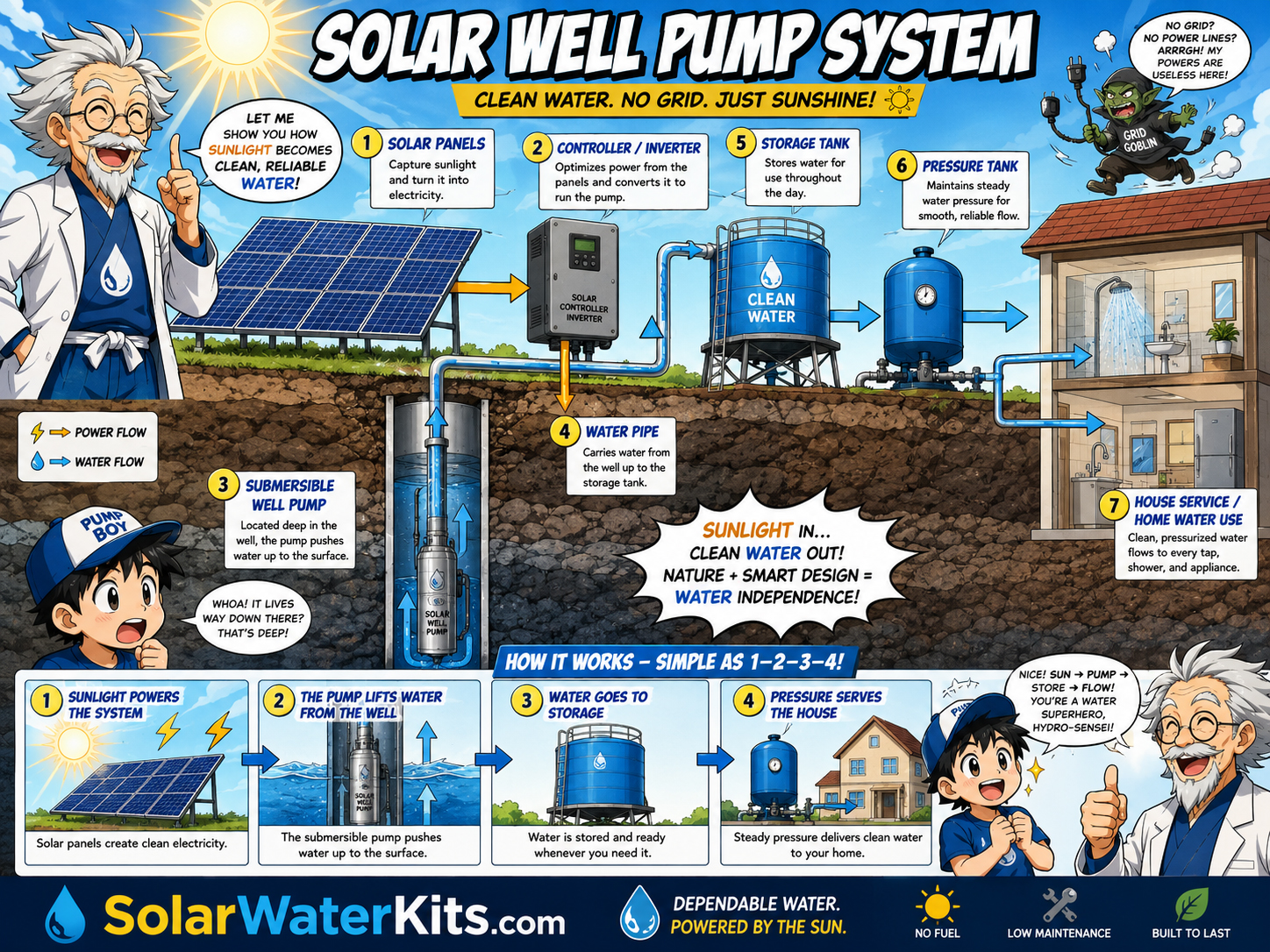
Source, pump, controls, storage, pressure, filtration, and use.
Someone asks if they can just draw water and drink it. Filter Ninja appears instantly. “Well water still needs testing. Clear is not proof.”
Pump breaker. Controller. Float switch. Tank level. Pressure switch. Filter bypass. Otaku Operator labels the system until Grid Goblin starts sneezing.
Battery Beast powers the essential pump load. Tank-chan receives storage. Hydro-Sensei limits water use. Grid Goblin retreats, muttering about “responsible design.”
Solar well pump planning begins with well depth, static water level, pumping water level, recovery rate, daily gallons, total dynamic head, storage, pressure, controls, power, and treatment.
Well depth, water level, recovery, pump type, and total dynamic head all shape the design.
Solar Well Pumps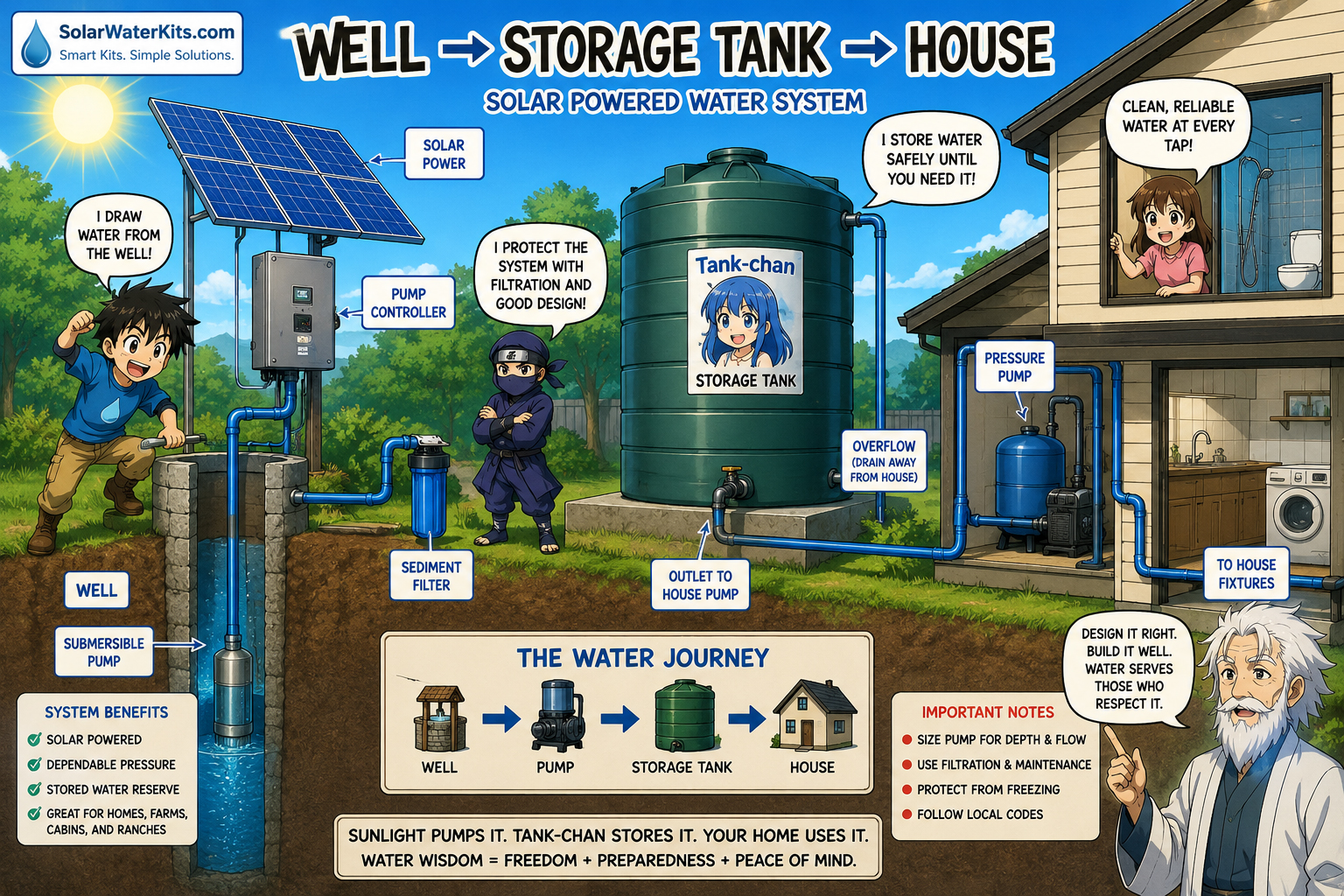
Pumping to storage can separate well-pump operation from household water use.
Stored Water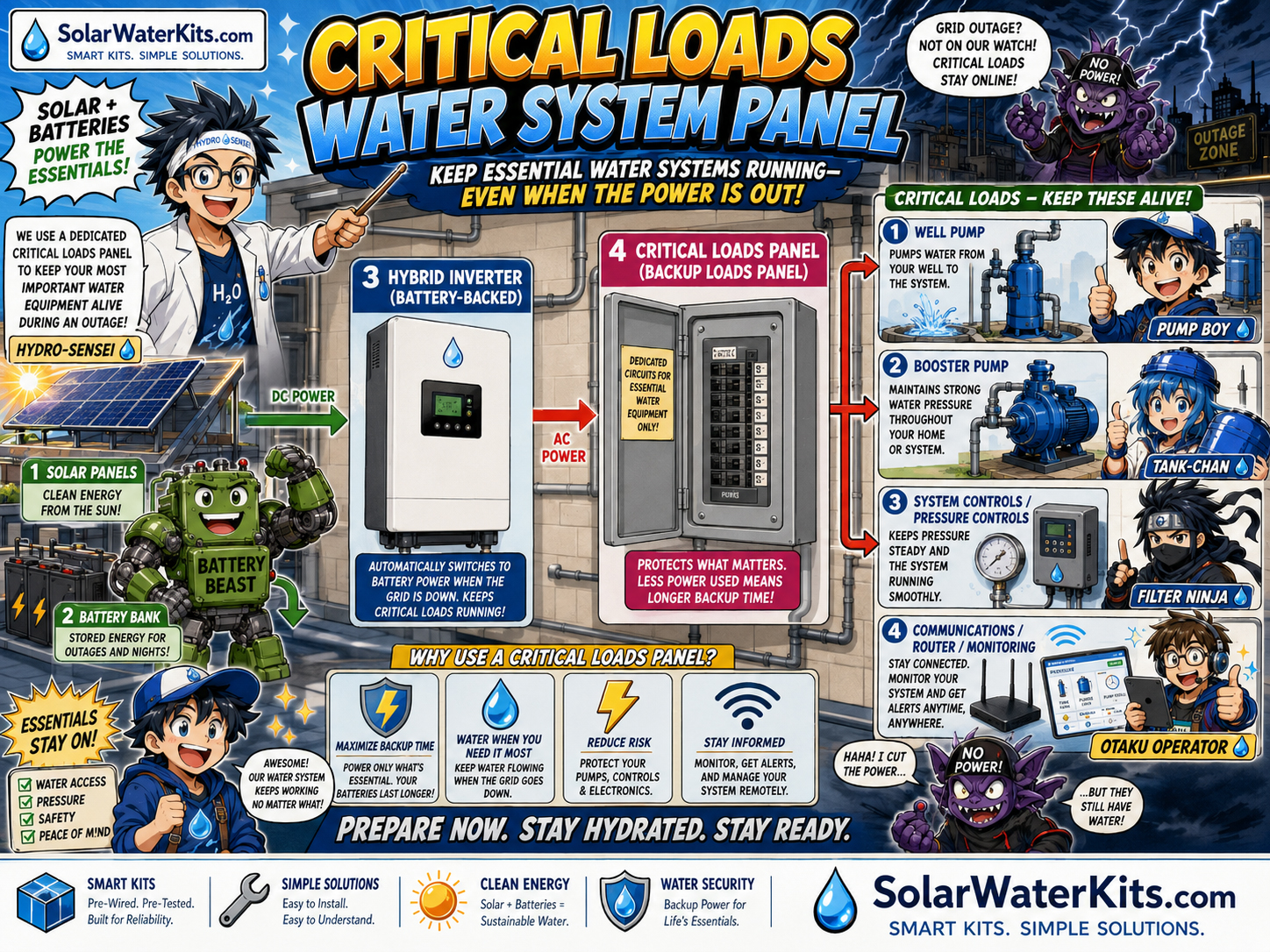
A well pump backup plan must match pump surge, battery capacity, inverter rating, and essential water needs.
Battery Backup| Well System Question | Why It Matters | Grid Goblin Trap |
|---|---|---|
| What is the static water level? | Shows where water sits before pumping. | Using total well depth as the lift number. |
| What is the pumping water level? | Shows how far water drops while pumping. | Sizing the pump from resting conditions only. |
| What is the well recovery rate? | Shows how quickly the source refills. | Installing a pump that outpaces the well. |
| What is the total dynamic head? | Includes lift, pressure, friction, valves, filters, and fittings. | Ignoring pipe friction and pressure needs. |
| What is the pump surge? | Determines inverter and battery requirements. | Assuming running watts are enough. |
| Where is the water stored? | Storage reduces instant pump dependence. | No storage, no buffer, no time. |
| Is the water safe? | Well water still needs testing and treatment where required. | Assuming clear well water is potable. |
The well is the source. The system is the delivery.
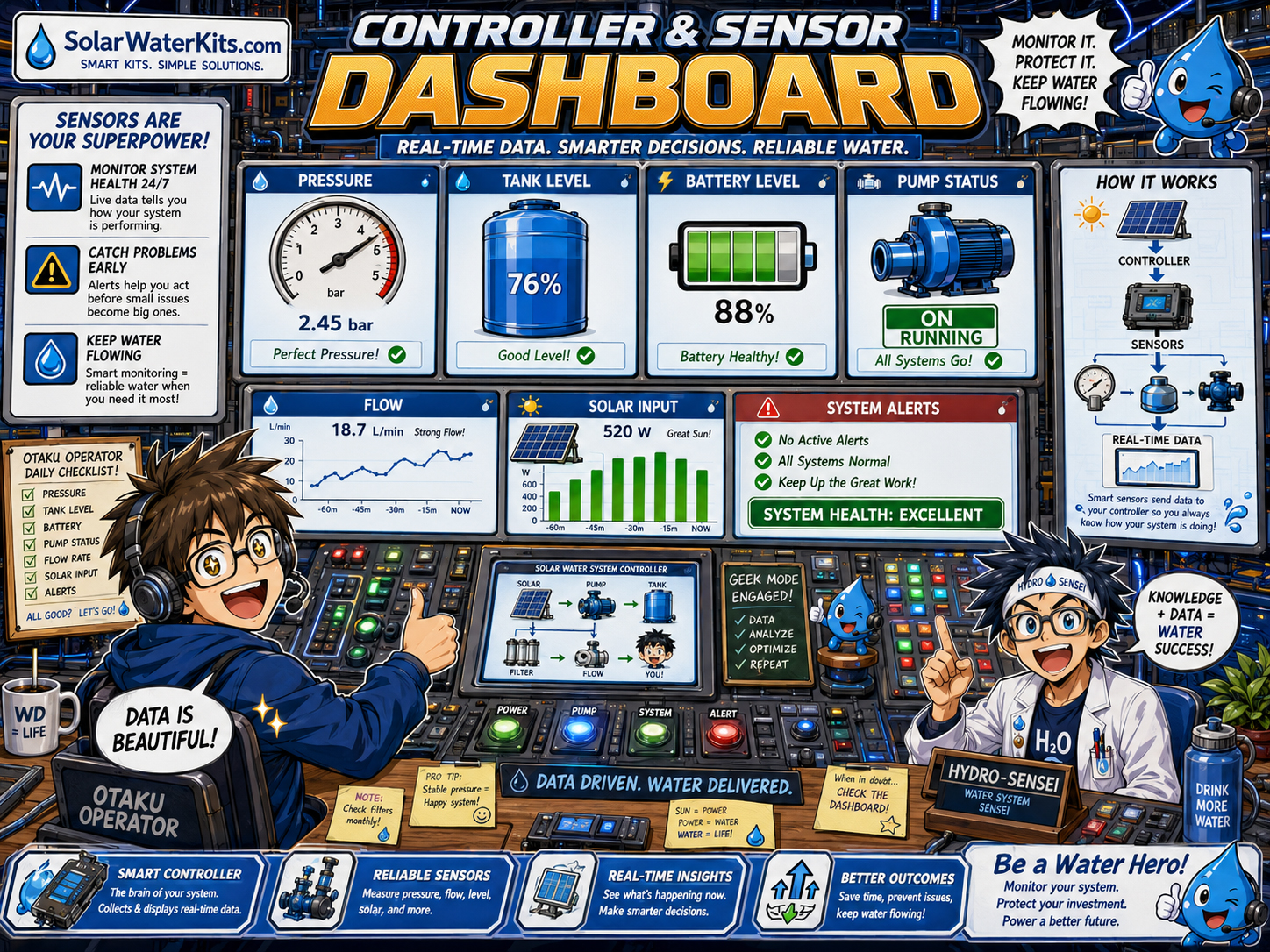
Pump status, tank level, pressure, battery state, and alarms reduce guessing.
The well may be full. The pump may be strong. The battery may be charged. The system still fails if storage, pressure, protection, testing, labels, and backup priorities are missing.
Pump Boy: “So the well was not the plan?”
Hydro-Sensei: “The well was chapter one.”
Real well pump systems may involve wells, submersible pumps, pump controllers, pressure tanks, potable-water plumbing, batteries, inverters, electrical panels, disconnects, grounding, pressure relief, filtration, treatment, backflow protection, permits, inspections, and water testing.
The crew learns that moving water is not the same as making water safe. Filter Ninja takes over the classroom.
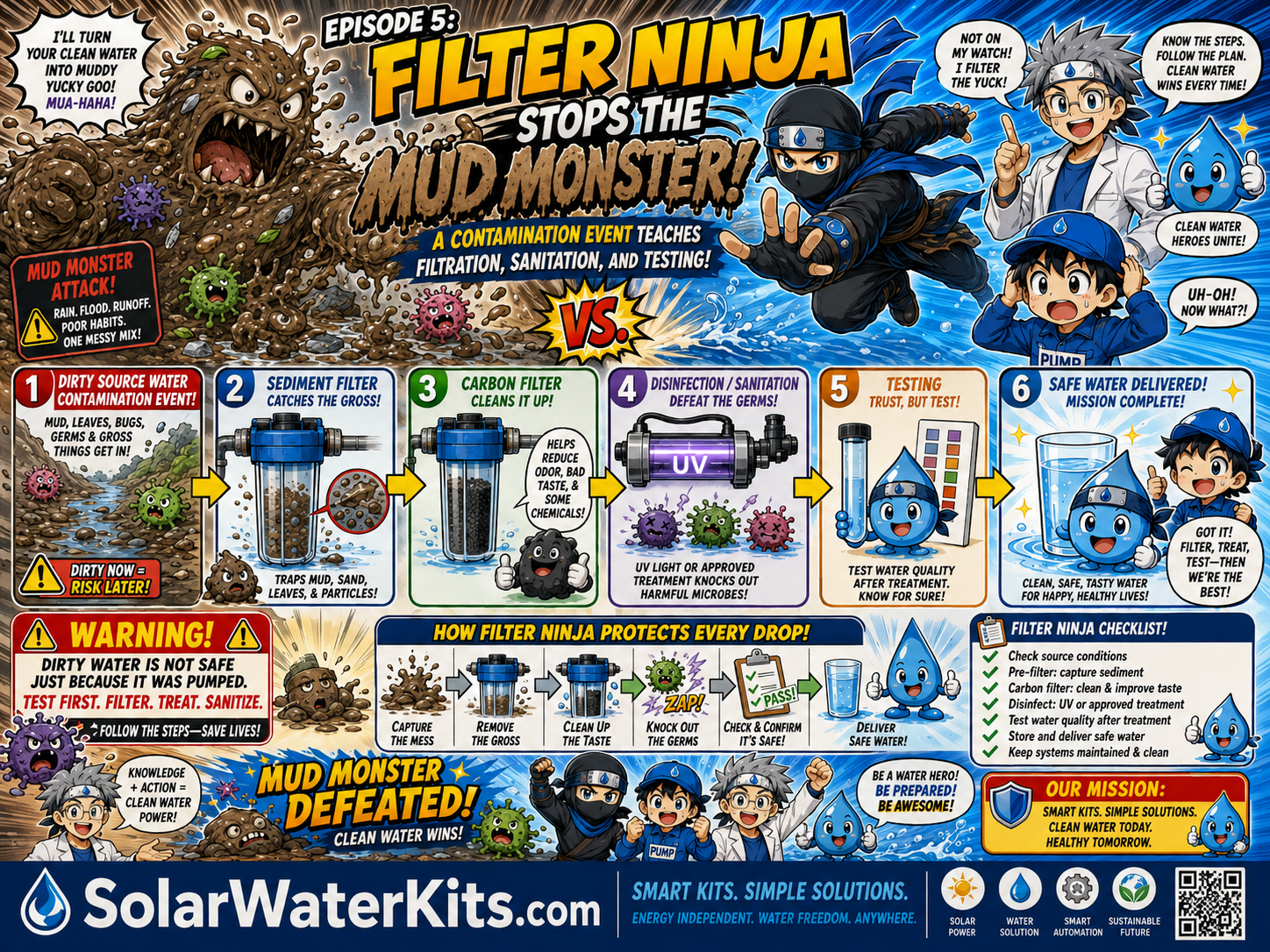
Contamination, filtration, sanitation, and testing enter the story.
Read Episode 5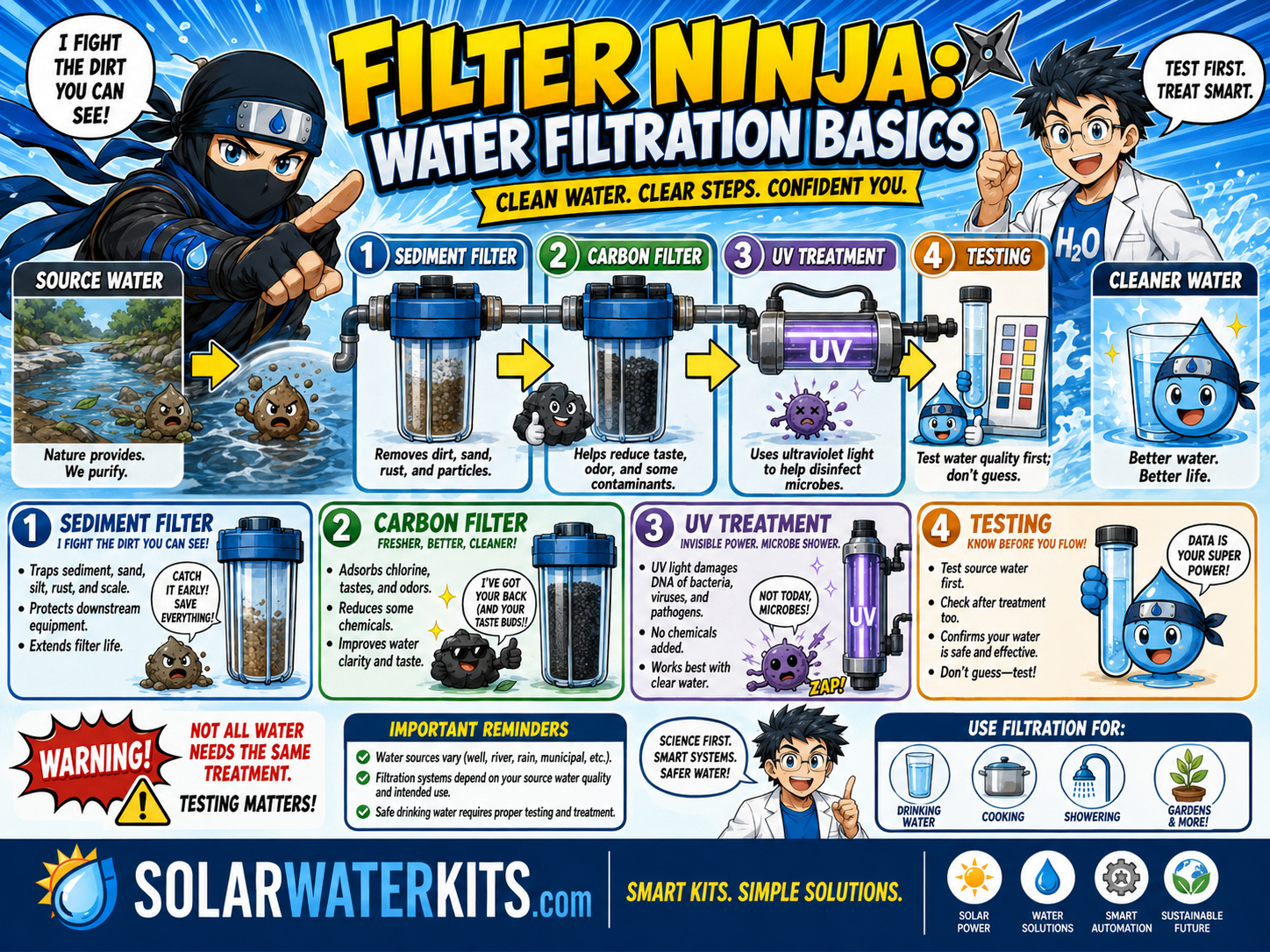
Learn why source water needs testing, filtration, treatment, and maintenance.
Filtration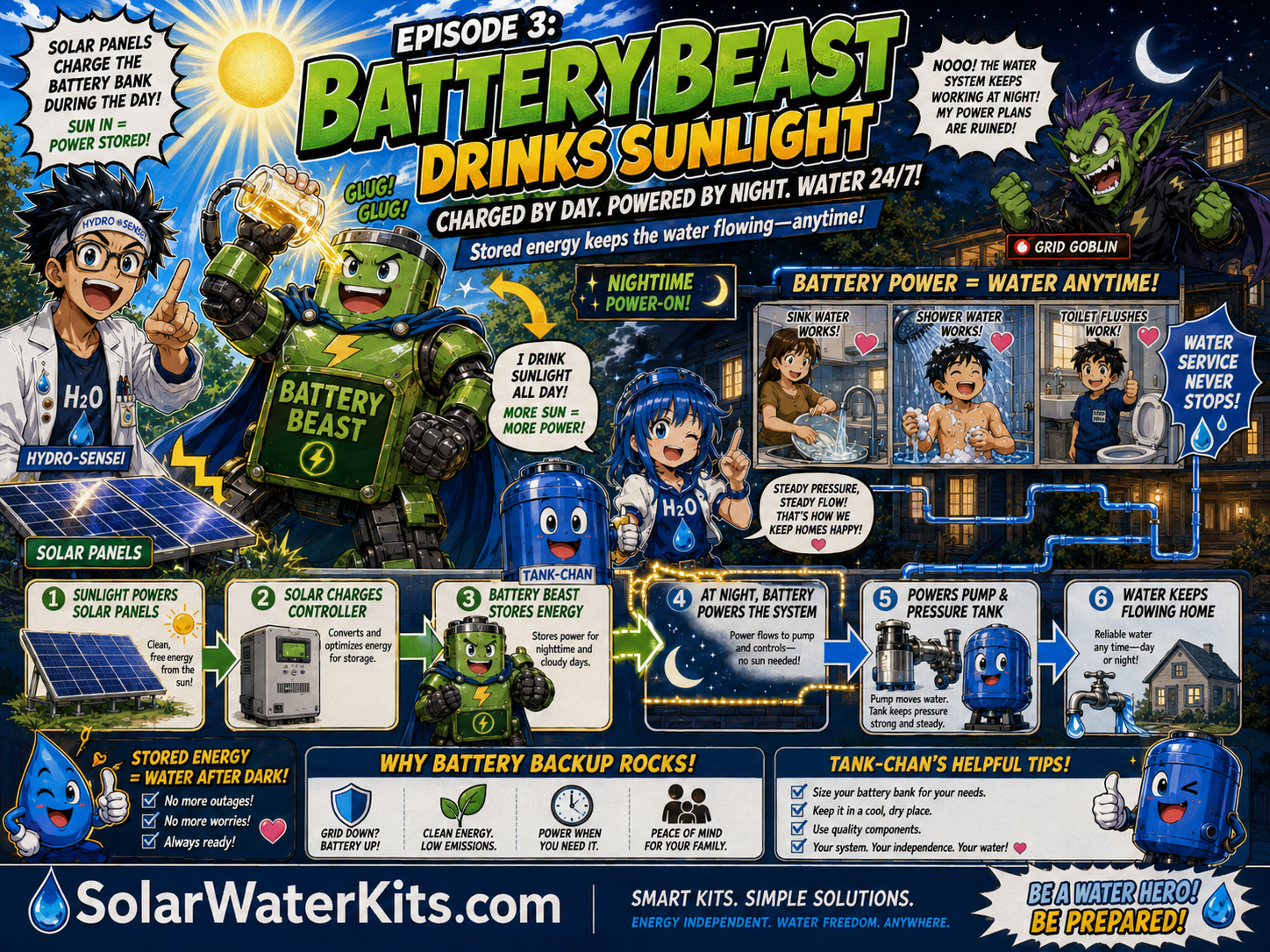
Go back to the battery backup runtime lesson.
Read Episode 3