🔋 Battery Beast Backup Lesson

Solar Battery Pump Backup

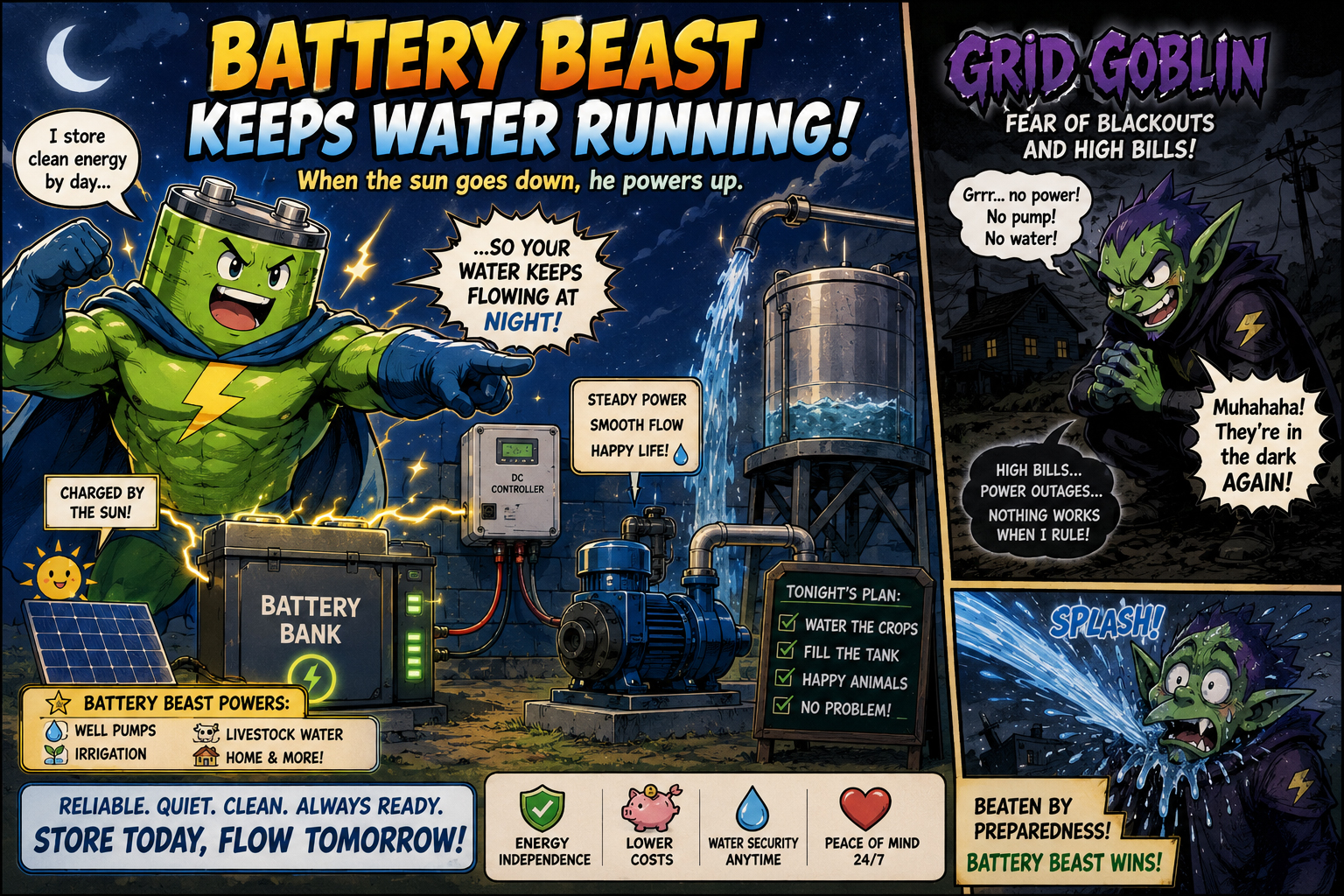
Battery Beast can help keep essential water moving during outages — but only when the pump load, starting surge, inverter, battery capacity, pressure system, storage tank, and critical-load plan are designed honestly.
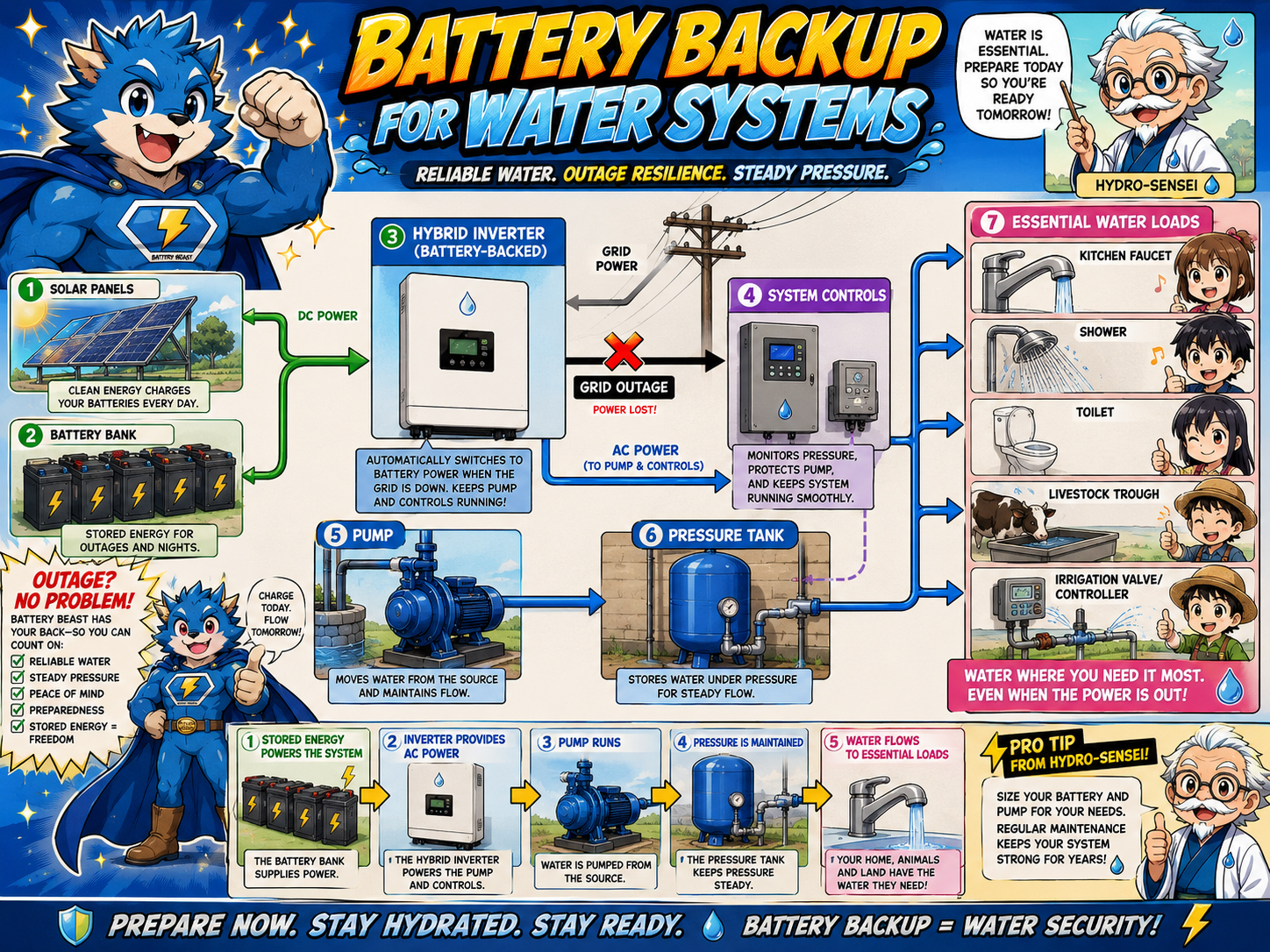
🔋 Battery ⚙️ Pump Surge ⏱️ Runtime 🛢️ Stored Water 🚰 Essential Loads
Battery-backed inverter powering pump, controls, pressure tank, and essential water loads.
Batteries are powerful. Batteries are not infinite.
Backup Basics

A pump backup system is electrical math plus water discipline

The battery does not know what you wished for. It only knows load, surge, runtime, state of charge, inverter limits, and how many water loads you connected.
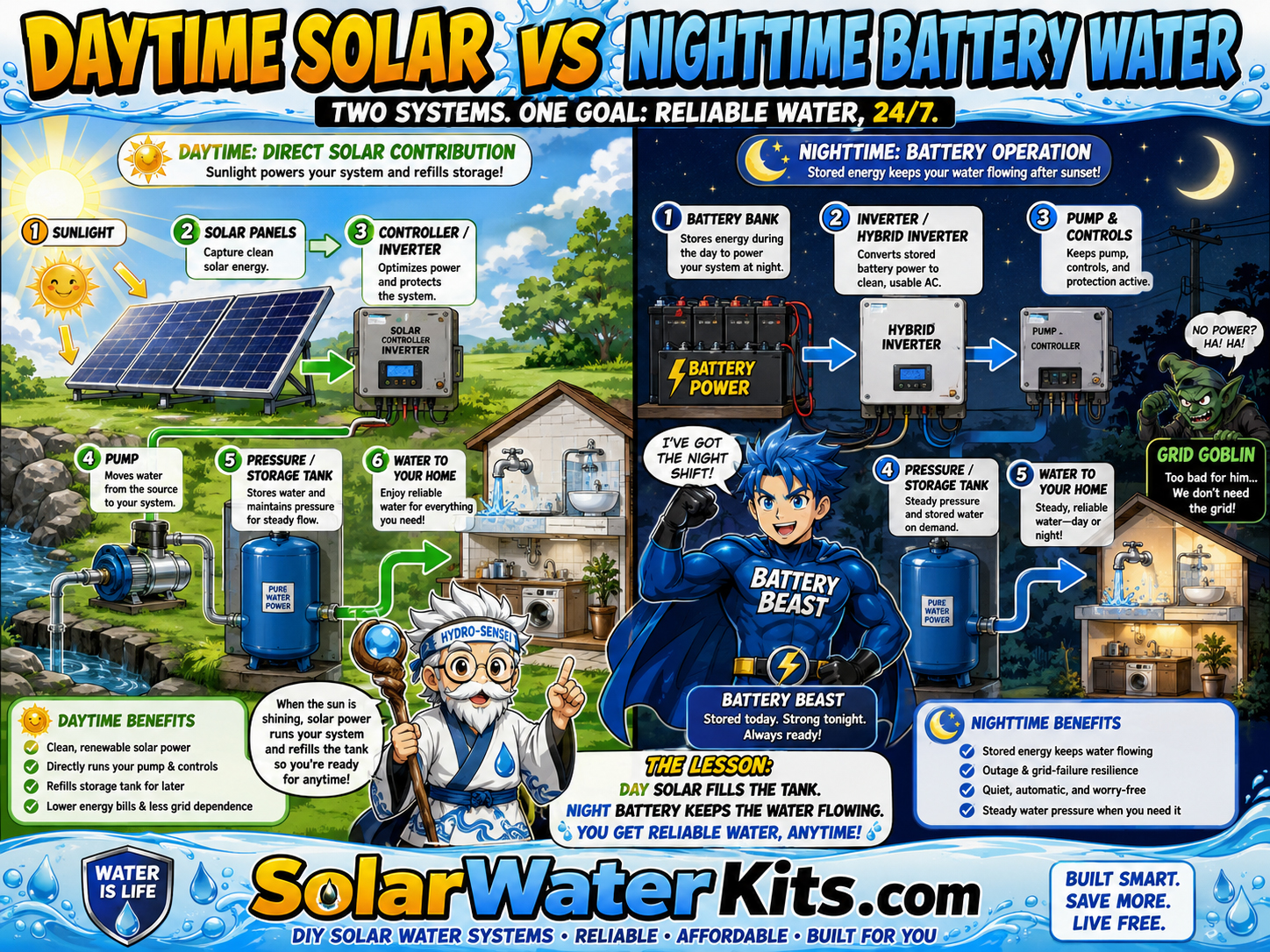
Battery Beast’s checklist

Backup water = pump load + surge + runtime + battery capacity + water priorities.
  • Know the pump. Voltage, horsepower, running watts, and starting surge matter.
  • Know the inverter. It must start and run the pump safely.
  • Know the battery. Capacity, chemistry, location, temperature, and reserve matter.
  • Know the water priority. Essential water comes before comfort water.
  • Know the storage. Stored water can reduce pump runtime during outages.
  • Know the controls. Float switches, dry-run protection, pressure switches, and alarms protect the system.
Critical Loads

Back up the important water loads first

Battery Beast should not be asked to run every water device on the property. A good backup plan starts with essential water.

Usually essential

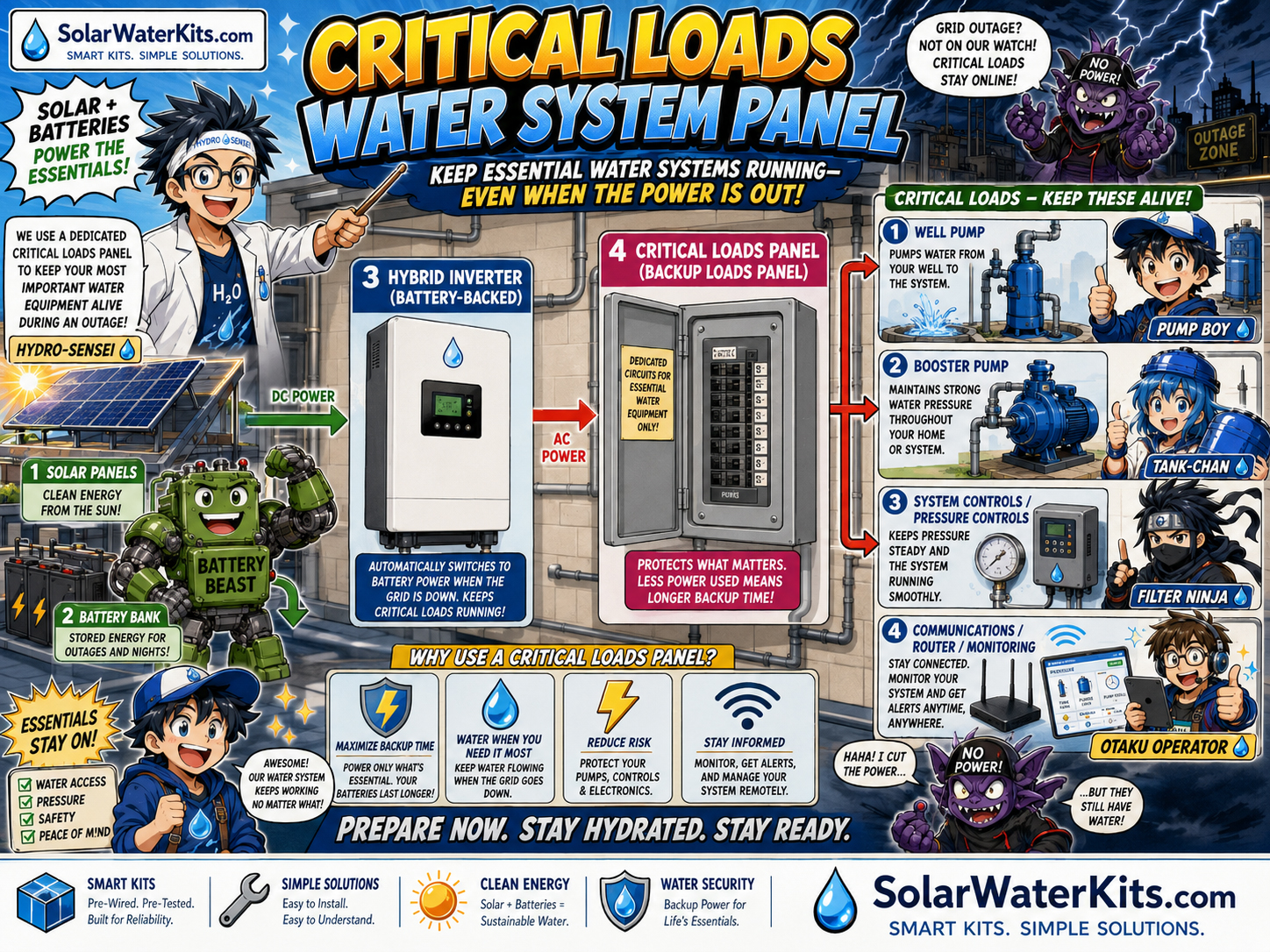
  • Well pump or source pump, if needed for drinking or sanitation.
  • Booster pump for essential household pressure.
  • Pressure switch, controls, and monitoring.
  • Basic sanitation and hand-washing water.
  • Animal water where applicable.

Usually not first

  • Pool pumps.
  • Large irrigation zones.
  • Long showers.
  • Decorative fountains.
  • High-flow hose use.

Needs design judgment

  • Pressure tanks and booster pumps.
  • Water treatment equipment.
  • Rainwater or cistern pumps.
  • Fire-readiness water concepts.
  • Freeze-protection equipment.

Hydro-Sensei says

“A backup panel is a priority list made out of wires. Choose the water loads before the outage chooses for you.”

Surge and Runtime

Starting the pump is often harder than running the pump

Two numbers matter immediately

Pumps with motors may need a large burst of power to start. That starting surge can be much higher than running watts. The inverter must handle both.
Running watts: what the pump uses after it is already running.
Starting surge: the short burst needed to start the motor.
  • Check pump nameplate data.
  • Check locked-rotor or starting current where available.
  • Check inverter surge rating and duration.
  • Check wire distance and voltage drop.
  • Test the system under real pump load before outage season.
Backup Question Why It Matters Battery Beast Warning
Which pump is backed up? Well, booster, transfer, and pressure pumps have different loads. Do not say “the pump” until you know which pump.
What is the starting surge? Motors may require more power to start than to run. An inverter may run lights but fail to start a pump.
How long must it run? Runtime determines battery energy needed. Minutes matter. Hours matter more.
What water uses are essential? Essential loads preserve battery and stored water. Do not back up comfort loads before survival loads.
Is there stored water? Storage can reduce how often the pump must run. Sometimes storing water beats storing more electricity.
Are controls and labels clear? People must know what the backup system powers. Mystery panels drain batteries and patience.
Storage + Pressure

Water storage helps batteries last longer

A tank full of water can reduce how often the pump must run during outage mode. Pressure tanks can reduce unnecessary starts. Battery Beast appreciates both.
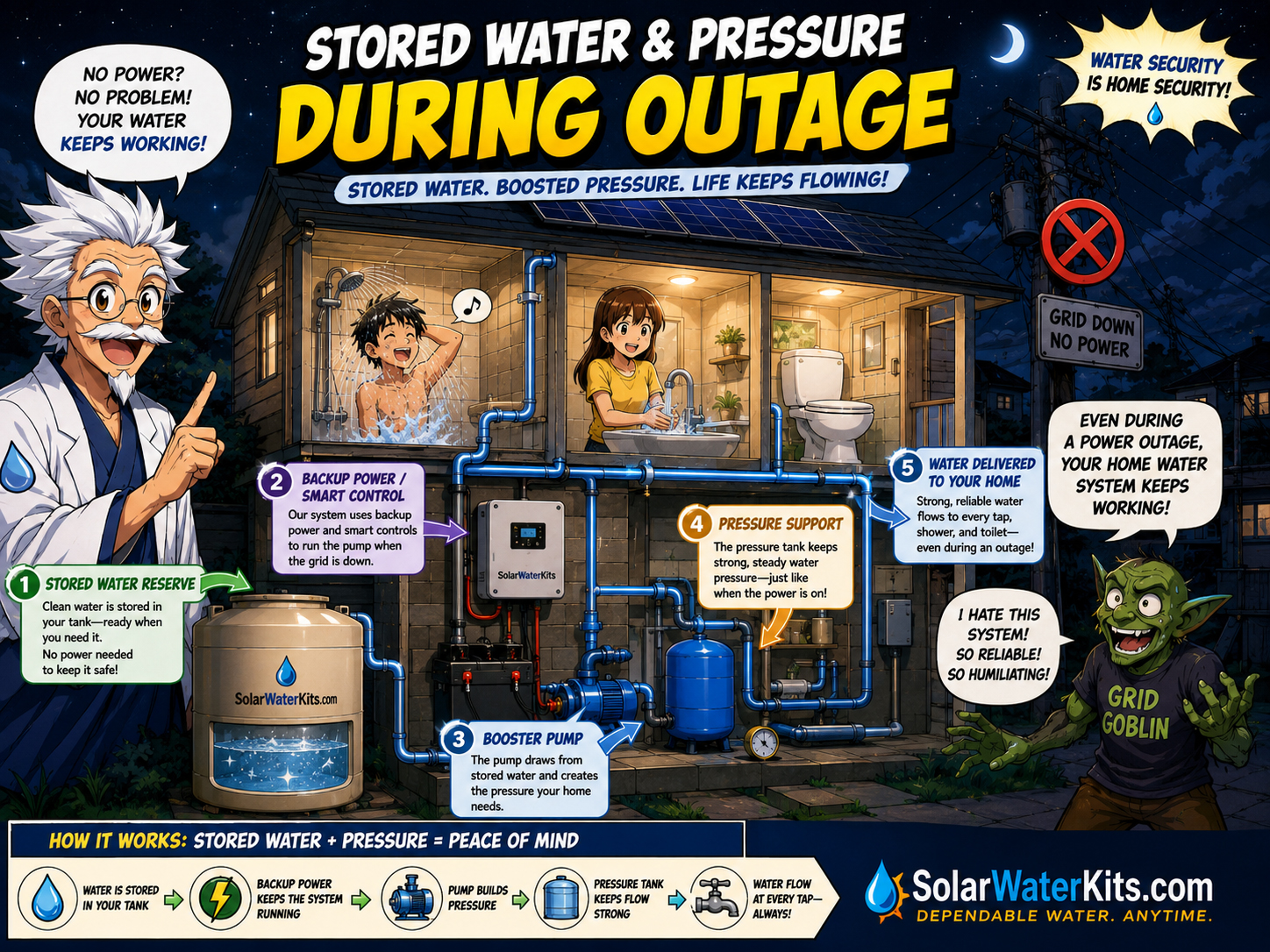
Stored water and pressure during an outage.
Stored Water

Tank reserve

Stored water can serve the system before the pump must run again.

Stored Water
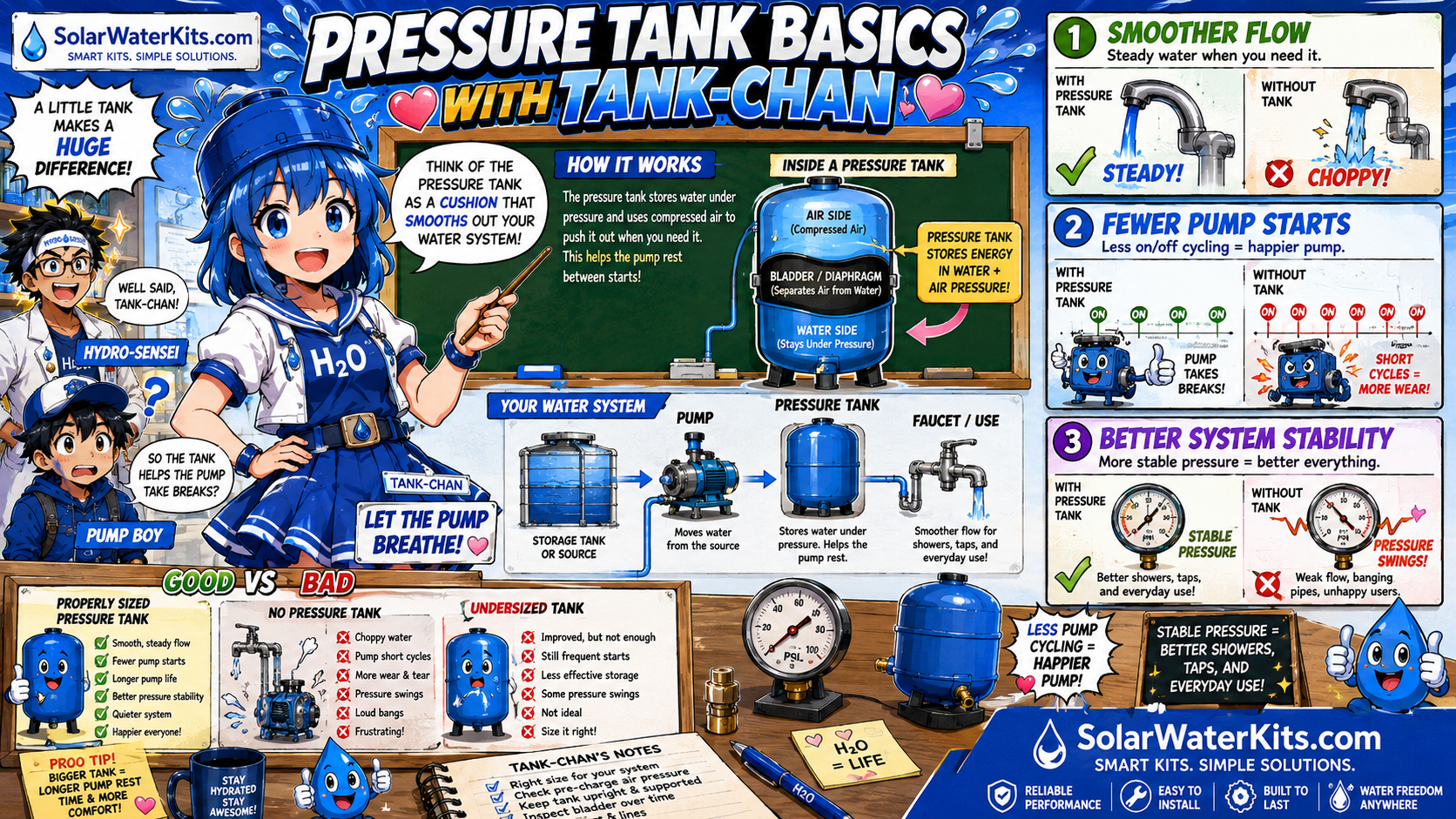
Tank-chan teaching pressure tank basics.
Pressure Tank

Fewer pump starts

Pressure tanks can reduce short-cycling and smooth small draws.

Pressure Tanks
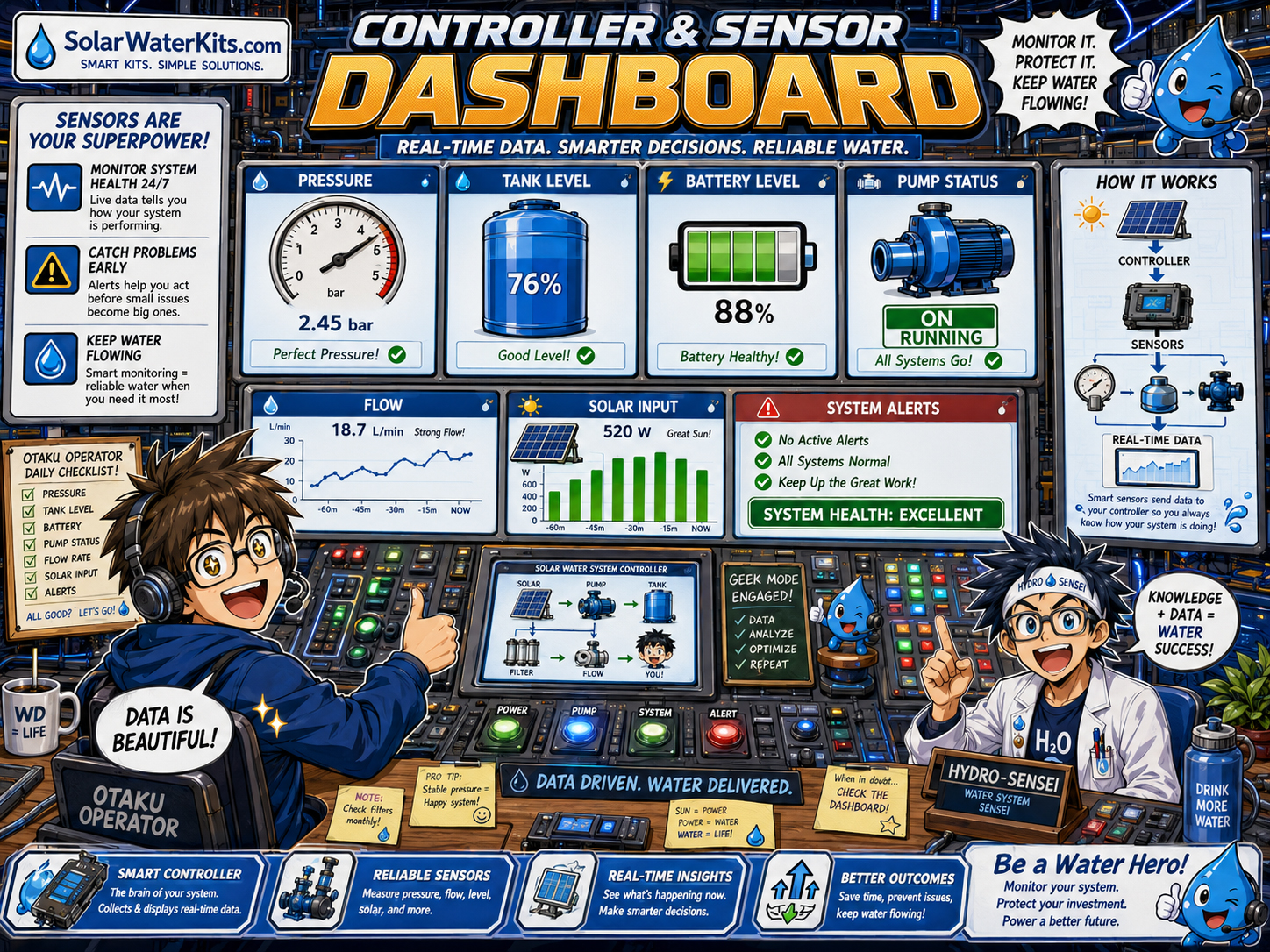
Otaku Operator monitors pressure, tank level, battery level, pump status, and sunlight.
Controls

Status prevents panic

Tank level, battery state, pump status, pressure, and alarms help users make decisions.

Controls

Battery Beast says

“Do not ask me to start a big pump every time someone rinses a cup. Let Tank-chan and the pressure system help.”
System Design Checklist

Backup water needs both electrical and plumbing review

Electrical checklist

  • Pump voltage and phase are known.
  • Running watts or amps are known.
  • Starting surge is known or measured.
  • Inverter is rated for pump start and run.
  • Battery capacity matches essential runtime.
  • Disconnects, breakers, grounding, and wire sizing are reviewed.
  • Battery location, temperature, and clearance requirements are followed.

Water-system checklist

  • Essential water loads are listed.
  • Storage tank level is monitored.
  • Pressure tank behavior is checked.
  • Float switches and low-water cutoffs are tested.
  • Filter and treatment status are known.
  • Potable and non-potable water remain separated.
  • Outage-mode instructions are posted near the equipment.
Backup Use Cases

Battery pump backup changes by mission

Well pump backup

Needs pump data, well behavior, surge review, water storage, pressure delivery, and low-water protection.

Well Pumps

Household pressure backup

Needs booster pump sizing, pressure tank behavior, essential fixture priorities, and a clear outage-mode plan.

Emergency Water

Ranch water backup

Needs stored water, trough inspection, float valve protection, animal demand, and backup fill methods.

Livestock Water

Cabin water backup

Needs seasonal shutdown, freeze protection, filtration, pressure, and low-power operation.

Cabin Water

Fire-readiness water concepts

Needs evacuation-first thinking, professional review, stored water, pump capacity, and code boundaries.

Fire Readiness

Freeze protection loads

Heat trace, recirculation, or alarms can drain batteries if not planned carefully.

Freeze Protection
Battery Pump Backup Safety

Battery-backed pumps require qualified electrical and plumbing design

Real battery-backed water systems may involve batteries, inverters, solar arrays, electrical panels, pumps, wet locations, grounding, disconnects, overcurrent protection, pressure tanks, potable-water plumbing, filters, backflow protection, permits, and inspections.

Do this

  • Use qualified electrical, plumbing, pump, solar, battery, and water-treatment professionals where required.
  • Confirm pump voltage, starting surge, running watts, and runtime.
  • Use properly rated batteries, inverters, wiring, disconnects, and protection.
  • Separate essential loads from nonessential loads.
  • Test the backup system under real conditions.
  • Follow local codes, permits, and manufacturer instructions.

Do not do this

  • Do not improvise pump wiring or battery connections.
  • Do not assume a small battery can run a large pump all night.
  • Do not keep resetting tripped equipment without finding the cause.
  • Do not ignore battery location, ventilation, clearances, or temperature limits.
  • Do not connect non-potable water to potable plumbing casually.
  • Do not treat this page as a permit drawing or installation manual.